Showing posts with label Keynesian. Show all posts

Thursday, August 2, 2012

Failure of The Ideal

In this post, Peter Radford articulates my evolved understanding of economics so clearly, deftly & succinctly that I had to re-post here in its entirety (with my emphases added in highlight):

The past few weeks have been fraught on a number of fronts.  Two of our most important industries: banking and auto making are decidedly sick.  Unemployment is rising.  Housing is still in the tank. Stores are having a hard time attracting customers.  And the airwaves, news media, and blogosphere are all ablaze with experts, faux experts, and wannabes tossing around every pet theory under the sun. Amidst all this we have a new administration trying to avoid compounding the errors of its predecessors, and yet still trying to plug the holes its sees as the most dangerous.  Its motto is that of medicine: “First do no harm.”
One of the reasons I find all this so compelling, some might say exhilarating, is that we find ourselves at a crucial moment in time.  The policy steps we take and the solutions we use to fix our evident problems will define, most likely, the next two or three decades.  For those of us who have a perspective on what that definition ought to be, now is the time to speak up. Having a voice  on such formative and critical matters is both a privilege and a responsibility. One of America’s most cherished concepts of itself is exactly that: the ability to have a say is democratically available.  The words: ‘We the People’ have concrete meaning and confer a responsibility on all of us to be involved. That’s why I run this blog.  And I am sure that’s why all the others speak up too.
But, as Winston Churchill famously argued, democracy is awfully messy.  So the noise can be raucous.  And the debate heated.  Human relations are, after all, human.  That means they are imprecise, prone to excess, and riddled through with error.  The only thing we all can ever know is that we were most likely mistaken just when we were most certain.
In fact I find certainty, or the notion that one can ‘know’ something with certitude to be a sure indicator of falsehood.
My first exposure to this rejection of certainty came a long time ago when I was studying philosophy. I am naturally skeptical with a deep rooted non-conformist streak that I attribute to my upbringing in Eastern England, which, long ago, was the center of rebellion against both the monarchy and the established church.  Many of the original ‘pilgrims’ so celebrated here in America came from the towns and villages around where I grew up, and I have always felt a deep connection with the New England form of the American story.  So when my education threw me up against Plato I naturally recoiled in horror.
He was wrong and I knew it.  But he was Plato and I was me.  So I tried to understand what I was missing.
Nothing as it turns out.
My savior was Karl Popper who was an emeritus member of the college I attended, and whose attack on Plato, Hegel and Marx – “The Open Society and Its Enemies” – allowed me to breath more easily. He led me to others including Machiavelli, Vico, Hume, and Darwin, and eventually guided me towards an acceptance of the futility or the arrogance inherent in the statement ‘I know’.
I don’t.  Nor does anyone else.  That should engender humility and openness in our enquiries and it should also allow us to embrace the foibles of our species, which is, after all, something of a parvenu on the world stage.  One of the great triumphs of the recent past is that we realize that we know so little and that all we know can be overturned in the future.  Indeed we should seek to overturn it ourselves, because it is the relentless questioning of what we currently accept as ‘truth’ that allows us to press forward and learn more.
Alongside Popper I sit Kant who seems to have spent his entire life trying to impose rigor on the fabric of morality even though he, in a moment of clarity, saw that ‘Out of the crooked timber of humanity, nothing straight was ever made’.  So why did he bother?  Because of his restless need to attempt to establish an ideal?  I think it was more that he desperately wanted humanity not to be hewn from ‘crooked timber’, or rather he saw better than the rest of us that our ‘crookedness’ needed constraint.  Hence his ‘categorical imperative.’
Absorbing all this while at the same time trying to learn economics led me to question what was then emerging as its new standard theoretical basis.  There was far too much certitude built in and not enough humanity.
It is that error: the belief in certainty we are now paying the price for.
Standard economics, the kind you find in most textbooks here in the US, concerns itself with enquiry into the mechanisms and effects of markets.  It asks questions about the ramifications of changes within the systems it studies, and it draws conclusions about the conditions necessary for an economy to reach an optimal allocation of resources.
Rather than studying actual economies and theorizing about actual objects within them, economists prefer to study abstracted models.  These models  are highly simplified and idealized versions of the world and are expressed mathematically as series of connected equations.  The centerpiece of the standard theory is something called General Equilibrium Theory that purports to illuminate the conditions necessary for the achievement of optimal resource allocation.  Surrounding this are bits and pieces that contribute to the whole by eliminating technical problems that interfere with the search for an optimum.  These bits and pieces include such things as revealed preference theory, the efficient markets hypothesis, agent rationality and so on.
This all sounds arcane.  It is.  It is the handiwork of numerous extraordinarily bright people spread over decades.  It is rigorous.  It is thoroughly explored.  It is expressed in enormous detail.
And it is of not much use.
Indeed in many ways it is a simple tautology.
It incorporates certainty in some of its details, and thus can never be representative of a real economy.
One of its central components is that the agents within an economy – Milton Friedman used to refer to them as ‘economic units’, I prefer to call them people – are rational and have full and costless access to perfect information.  That is I know what you know, and we both know everything.  Absolutely. No exceptions.  We are omniscient.  This is a necessary condition for the models to work.  For if I know something you don’t, and I act upon it, there can be no assurance that the result of all the transactions of our economy would yield an optimal outcome.  How would we know it was optimal?  There may be actions we could take that would move us to a better outcome.  But since you are not fully aware of what I know we cannot, either of us, arrive at an understanding of what an optimum may be.
Since they were searching for a model that resulted in an optimum economists were forced into eliminating reality.  They started to tinker with an idealized system.  That way they could explore its allocative properties, and the problems associated with changes to it.  They believed they had established a laboratory within which they could study markets.
The odd thing is that they chose assumptions and axioms that predetermined the outcome: the object in their laboratory was a perfect or idealized market.
So it is not odd that economists became convinced that markets are the ideal method for allocating resources.
They went in a great long intellectual circle: they set up a idealized market in order to ‘prove’ that markets are ideal.
The fact that their assumptions are absurd – do you really know everything? – didn’t matter as long as the outcome was ‘correct’.  And ‘correct’ was determined a priori: markets are better.
This may seem confusing.  Let me re-state it: instead of studying the real world, economists study idealized models.  Those models are descriptions of ideal markets.  From this they determine that markets are ideal.  Other forms of resource allocation, such as central planning, are deemed inefficient by comparison with markets on the basis of these models.
Milton Friedman, in 1953, was famously  forced to defend the absurdity of these assumptions and this whole process of economic theorizing.  It is his assertion that if the outcome is ‘correct’ then the absurdity of the input is irrelevant that I mentioned above.
So that is the state of economics.
The ideal.  Certainty.  Intertwined concepts threaded throughout the edifice.
A natural conclusion to draw from this effort is that markets are always correct in their pricing of something.  If markets are efficient in the sense that Friedman and his ilk argue, then the prices expressed in those markets must, by definition, be ‘correct’.  So a home price in 2002 of $125,000 is correct, and so is the 2007 price of $750,000, for the exact same home.  And so is its price of $500,000 today.
It was this belief that allowed Alan Greenspan to ignore the asset price bubbles of the 1990′s and 2000′s.  He reasoned, from his standard textbook position, that escalating prices were ‘correct’.  Any correction in those prices must be an expression of underlying economic conditions that the market was capturing.
The problem I find with this is that it is vacuous statement.  There is no analytical content in the notion that markets are always correct.  It merely sets up a regress to explore for other phenomena causing change.  For if markets are always correct they are never the cause of anything.  They are simply blind mechanisms expressing something else.  The causes of change must lay outside the system.  To use the word economists have for such things: the causes are ‘exogenous’.
In that case people must be ‘exogenous’, since very few I know have the perfect information economists attribute to them.
That is to say the markets economists study, because they are ideal, have no people in them. The denizens of the models economists study are rational agents.  Not people like you and me.
This bizarre pursuit of the ideal would be quaint and perhaps a little eccentric were it not for the very large fact that the standard models view that markets are ‘always correct’ is a very attractive ideological view also.  It plays directly into the hands of those politicians who want to prevent the use of central planning, i.e. the government, in our economy.
In a way we should not be surprised by this confluence: economics has its origins in the intellectual discussion of the consequences of industrialization.  Most of its early thinking was directed toward understanding the then newly emergent industrial economy and, naturally, many of the problems that attracted analysis were those that vexed politicians of the day. Trade; labor laws; the increasing complexity of society; poverty; wages; and so on represented different problems now that industrialization had irrevocably altered the social landscape. Even the basic components of economic modeling: land, labor and capital belie their origins in the debates of the mid 1800′s.  The newly enriched commercial class longed for intellectual authority.  As modern society shed its aversion to the accumulation of capital it needed new theories to justify the new social structure.  From Aristotle to Aquinas the dominant intellectual tradition was to regard profit as immoral.  This had to be replaced.
In parallel the commercial class wanted to throw off the yoke of government interference.  Levels of taxation; the right to print money; and the respective roles of government and industry had to be worked out.
So starting in France with Boisguillebert and Cantillon; then in Britain with Smith, Ricardo, Malthus, and Mill modern economics began to take shape.  At its core was the ‘magic’ of the market that Smith identified and immortalized with his metaphor of the ‘invisible hand’.  This magic caused the self interest of individuals to be translated into social welfare.  So instead of being venal the desire to make profit became a virtue.
And the commercial class was thus liberated from the Middle Ages.
But economics was not yet obsessed with the ideal.  The great systems of Ricardo and Mill were not rigorous mathematics and they were referred to as ‘political economy’ in recognition of their relationship with current social issues.
The pursuit of certainty began in earnest much later.
As economics matured a growing need for rigor crept in.  The contemporary triumphs of physics and the increased ‘formalization’ – mathematical expression – of science pressed economists toward their own adoption of formal theorizing.  This desire accelerated quickly and decisively in the early 1900′s, such that by mid century mathematical modeling dominated.  Paul Samuelson being the most prominent architect of the new method. Textbooks after him have been highly dependent on mathematics.  Before him, in the work of Alfred Marshall, whose book was the standard text for decades, mathematical analysis was limited and confined to appendices.
With mathematics came rigor.  The subject was no longer ‘political economy’ but rather simply ‘economics’ and the last vestiges of real world human action was hived off when economics and sociology parted company in the 1930′s.  While the leading sociologist of his day, Talcott Parsons, was only too happy to carve out space for the nascent subject of sociology, the split left economics the poorer.  It left thinkers like Veblen, Weber, Durkheim, and more recently Granovetter and Fligstein, looking in at what was increasingly a self-referential and formal exercise in applied mathematics.
And all the while the effort within economics was the exploration of Smith’s magic.
There was one exception: Keynes in the mid 1930′s.  His argument became anathema to standard economists precisely because it built upon the insight that there are times when markets are not efficient. They are not always magical.  Sometimes they can act perversely. Indeed they can spiral out of control.  And the forces that cause this instability are within the system, they are not ‘exogenous’. Keynes thinking represented a shocking, and if correct, devastating critique of the then emerging standard view.  For the next few decades Keynesian economics, because it seemed to describe reality so well dominated public policy, but beneath the surface economic theorists bridled at the notion the the magic was not ideal.  They wanted to recapture certainty.  Eventually the stagflation of the mid 1970′s undermined Keynes. Central to the counter attack was the undoing of the theory that related unemployment and inflation – the so-called ‘Phillips Curve’.  Stagflation seemed to contradict Phillips.  Only policies based upon the idealized system: for instance, the new monetary theories of Freidman, had effect.  The Keynesian domination toppled and the new synthesized and formalized system of the ‘New Clasicists’ reigned supreme.
Now what we have is the sterility of the de-humanized General Equilibrium Theory and its hangers-on.
The consequence has just been played out.
The triumph of the new classicists and their unshakeable faith in markets led directly to Reaganism.  It led to deregulation.  It led to the political view that ‘government was the problem’.  The triumphant world view was that markets, and their magic, if left alone would always produce a better allocation of wealth than any system in which the government played an active role.
Further, an offshoot of the new classical theory, the efficient markets hypothesis, laid the groundwork for modern portfolio theory and the ‘Black-Scholes-Merton’ model for options pricing.  This latter was used, in turn, as the basis for the construction of the market for options.  Up until Black-Scholes-Merton most states in the US regarded options as simple gambling.  So no exchange for trading options could be built.  The model changed that.  The Chicago Exchange for trading options was permitted by the SEC partly because Milton Friedman called and persuaded its then head that the theory underlying options trading was impeccable.  Nobel Prizes were handed out to its developers.
So the derivatives business owes its existence to the relentless pursuit of the ideal and the the belief in certainty the lie at the heart of the new classical system.
This idealized system, Smith’s magic, had moved from being a theory about the world, to being a technology deployed within the world.
But unlike technologies based upon physics or chemistry, this one had inherited a fundamental flaw: its reliance on the absurd assumptions that were necessary to force the new classical models to describe an ideal market.  One outcome of this flaw was that derivatives traders used idealized distributions of probabilities in their own modeling: they employed a Gaussian distribution – the ‘normal’ or ‘bell’ curve – for loss event estimation.  The real world rarely conforms to such a distribution, but it was embedded in the ideal world upon which the derivatives models were based.  That was accepted theory, indeed it was ‘high’ theory. It was inviolate.  No one could assert that it was incorrect.
As we now know that inherited flaw brought our economy to its knees.
It is not a trivial statement to suggest that new classical economic theory was a prime cause of our recent crisis.  I believe it to be the case.  Economic theorists have a responsibility that extends beyond the safety of their classrooms.  It reaches right into the foreclosed homes, lost jobs, destroyed lives, and diminution of wealth that their obsession with ideal markets has wrought.  That they defend themselves with arguments based upon the ideal is testimony to the bankruptcy of their thinking.  
Economists like Barro, Lucas, and Mankiw are culpable. They share a burden along with their predecessors.  They built models to explore markets. Instead they convinced politicians that markets are perfect.  They became blinded by their own mathematics and its elegance.  They built a system unrelated to reality that had little explanatory power outside the ideal, and no predictive power at all.  They gave intellectual credibility to partisan and reckless fiscal policies, to ill thought out deregulation, and to the development of unsafe and unstable derivatives markets.  They created and supported a world view that found expression in thirty years of public policy – through administrations of both political parties – and which still pervades the thinking of our business and governmental elites.
Their ideas have been discredited on a monumental scale.
To say that it is unfortunate that the new classicists triumphed and dominated economics is to minimize the scale of the human cost their pursuit of the ideal caused.
The ideal failed.
As it was always doomed to.
Humans are not ideal.
Theories describing human activity, like that in markets, cannot be based upon an acceptance of certainty.  For there is no certainty.
We need a new economics.  Perhaps based upon evolution, that encompasses behavior, geography, culture, relationships, psychology and above all is inclusive of learning with all its fallibility.  It will be messy and imprecise.  It may elude formalization at the outset.  But it will be real.  For we must rid ourselves of the ideal.
Because this crisis above all else was a failure of the ideal

Monday, June 11, 2012

Did Republicans Deliberately Crash the US Economy?

Saturday, June 09, 2012

Did Republicans Deliberately Crash the US Economy?

Michael Cohen [w/ Mark Thoma commenting]

Did Republicans deliberately crash the US economy?, by Michael Cohen, CIF:
So why does the US economy stink?
Why has job creation in America slowed to a crawl? Why, after several months of economic hope, are things suddenly turning sour?
The culprits might seem obvious – uncertainty in Europe, an uneven economic recovery, fiscal and monetary policymakers immobilized and incapable of acting. But increasingly, Democrats are making the argument that the real culprit for the country's economic woes lies in a more discrete location: with the Republican Party.
In recent days, Democrats have started coming out and saying publicly what many have been mumbling privately for years – Republicans are so intent on defeating President Obama for re-election that they are purposely sabotaging the country's economic recovery ... in order to hurt Obama politically. Considering that presidents – and rarely opposition parties – are held electorally responsible for economic calamity, it's not a bad political strategy.
Then again, it's a hard accusation to prove: after all, one person's economic sabotage is another person's principled anti-government conservatism.
Beyond McConnell's words, though, there is circumstantial evidence to make the case. Republicans have opposed a lion's share of stimulus measures that once they supported, such as a payroll tax break, which they grudgingly embraced earlier this year. Even unemployment insurance, a relatively uncontroversial tool for helping those in an economic downturn, has been consistently held up by Republicans or used as a bargaining chip for more tax cuts. Ten years ago, prominent conservatives were loudly making the case for fiscal stimulus to get the economy going; today, they treat such ideas like they're the plague.
Traditionally, during economic recessions, Republicans have been supportive of loose monetary policy. Not this time. Rather, Republicans have upbraided Ben Bernanke, head of the Federal Reserve, for even considering policies that focus on growing the economy and creating jobs.
And then, there is the fact that since the original stimulus bill passed in February of 2009, Republicans have made practically no effort to draft comprehensive job creation legislation. Instead, they continue to pursue austerity policies, which reams of historical data suggest harms economic recovery and does little to create jobs. In fact, since taking control of the House of Representatives in 2011, Republicans have proposed hardly a single major jobs bill that didn't revolve, in some way, around their one-stop solution for all the nation's economic problems: more tax cuts.
Note to self: 
Here, there needs to be a discussion of the empirical historic track record [and theoretical underpinnings] for tax cuts as a job creation policy.  Based on the evidence I have seen to date, along with the plethora of known fatal flaws in the macroeconomic underpinnings of mainstream neo-liberal/neo-classical theory, tax cuts - alone - as a solution for job creation/restoring & sustaining full employment is at best inadequate and at worst may be wholly self-destructive for modern American capitalism.  But, lacking the data at my fingertips, it will have to wait for a later post.
Still, one can certainly argue – and Republicans do – that these steps are all reflective of conservative ideology. If you view government as a fundamentally bad actor, then stopping government expansion is, on some level, consistent. ...
It is also completely destructive of the very idea of democracy... even for our inspired Constitutional Republic. Those who do not believe in governance cannot but be bad at it.  See Thomas Frank (e.g.,  'The Wrecking Crew' and/or 'What's The Matter With Kansas?').
Presidents get blamed for a bad economy... The obligation will be on Obama to make the case that it is the Republicans, not he, who is to blame – a difficult, but not impossible task.
In the end, that might be the worst part of all – one of two major political parties in America is engaging in scorched-earth economic policies that are undercutting the economic recovery, possibly on purpose, and is forcing job-killing austerity measures on the states. And they have paid absolutely no political price for doing so. If anything, it won them control of the House in 2010, and has kept win Obama's approval ratings in the political danger zone. It might even help them get control of the White House.
Sabotage or not, it's hard to argue with "success" – and it's hard to imagine we've seen the last of it, whoever wins in November.
[Here Mark Thoma comments:

Has the Republican Party's strategy been deliberate? Yes, of course, the things the Party proposes do not fall randomly from the sky, they are the result of GOP choices. So the question of whether they did this on purpose is easy to answer, it's yes.

Is it intended to undermine the president's agenda? Again, of course it is. The alternative would be to support Obama's policies, and they aren't about to do that. So Republicans have been deliberately obstructive, and it would be hard to argue otherwise.

Have they intentionally done harm? This is where flip-flops from what Republicans supported in the past matters.

If they truly believed that all Keynesian type policies are harmful, then blocking them, and in the process blocking any policy at all -- which is essentially what they are doing since they surely know their pet policies have little chance of escaping a veto -- could not be considered an act of sabotage.

The policies may be quite harmful in reality, but if they truly believe they are avoiding harm by blocking stimulus policies it would be hard to accuse them of sabotaging the economy in order to make political gains.

But the fact that they have flip-flopped time and again on policies they supported when Republican presidents were in office and the economy needed help leads to the strong suspicion that blocking Obama's policy initiatives is a political strategy. The strategy is justified by a story about Keynesian economics being harmful that they clearly do not believe in their heart of hearts (witness, for example, Romney worrying about the consequences of the fiscal cliff, or their knee-jerk appeal to Keynesian principles when defense cuts are proposed). They have also concocted a story where a confidence fairy can make austerity work to support their ideological pursuit of smaller government.

But this is quite a departure from the stimulative polices that Republicans presidents have pursued in recent years giving it every appearance of a belief of convenience rather than of true conviction. To me, the refusal to support policies they would have supported had the president been a Republican tells me everything I need to know about whether this is strategic or a true belief.
    Posted by Mark Thoma on Saturday, June 9, 2012 at 10:36 AM]


    Friday, March 16, 2012

    Krugman Only Gets It half Right: Macro Retrogression in a Post-Keynesian World

    Paul Krugman on Milton Friedman:
    The truth, although nobody on the right will ever admit it, is that Friedman was basically a Keynesian — or, if you like, a Hicksian. His framework was just IS-LM coupled with an assertion that the LM curve was close enough to vertical — and money demand sufficiently stable — that steady growth in the money supply would do the job of economic stabilization. These were empirical propositions, not basic differences in analysis; and if they turn out to be wrong (as they have), monetarism dissolves back into Keynesianism.
    It’s worth pointing out, by the way, that this time the Fed did all that Friedman denounced it for not doing in the 1930s. The fact that this wasn’t enough amounts to a refutation of Friedman’s claim that adequate Fed action could have prevented the Depression.
    All well and good.  Krugman is almost certainly right... as far as he goes.

    What Krugman doesn't acknowledge is that not only does Friedman's monetarism collapse back into Keynesianism by virtue of the failure of its assumptions (LM curve verticality, stable money demand) to stand up to real world scrutiny, but that the Hicksian IS-LM framework itself is an utterly unrealistic, fundamentally incorrect construct that does not at all properly represent Keynesian macro theory. 

    Even the creator of IS-LM, JR Hicks himself, repudiated the model as virtual rubbish - over 30 years ago! - calling it nothing more than an interesting plaything useful only for classroom discussion. 

    Thus the underpinnings of the entire modern neoclassical macro theory (i.e., mainstream macro since Patinkin's post-Keynesian synthesis) -- which includes not only the Freshwater versions such as Friedman's or Mankiw's, but also the Saltwater varieties of Krugman, DeLong & Summers -- are banished to the dustbin of history. 

    Or, at least, they should be.

    Tuesday, November 8, 2011

    Some Capital-Theoretic Fallacies of Austrian Economics:

    Robert L. Vienneau
    October 2007

    This article demonstrates certain doctrines of the Austrian school of economics are untenable.

    The focus is on certain aspects of capital theory undergirding Austrian Business Cycle theory.

    Other criticisms of Austrian Business Cycle Theory from Cambridge-Italian economists are briefly surveyed.

    This paper demonstrates an entrepreneur may simultaneously classify a capital good into several orders, as orders of goods are defined by Austrian economists. Hayekian triangles are defined. This paper demonstrates that the shape of a Hayekian triangle varies with the interest rate, even if real resources are not reallocated across stages of production. It is demonstrated, by means of an example, that no tendency need exist for entrepreneurs to respond to lower interest rates by reallocating resources from producing low order goods to producing higher order goods, or otherwise increasing the capital-intensity of the structure of production.

    Conclusions:
    This paper poses a challenge to advocates of ABCT (Austrian Business Cycle Theory) – to either recant their advocacy or to retell their story with correct capital theory. In such theory, no presumption exists that entrepreneurs will systematically direct more resources to producing higher order goods and away from lower order goods when the interest rate is lower.
    Whether the details of the ABCT can be reformulated to withstand capital-theoretic critiques remains to be demonstrated.

     
    And a full library of criticism of the Austrian School of economic thought can be found at the Critiques of Libertariansim site.
    The full article is here.

    Some Capital-Theoretic Fallacies of Austrian Economics

    Wednesday, October 26, 2011

    Why ‘Occupy Wall Street’ Makes Sense: Lessons Economists Could Learn from the 99% | Steve Keen's Debtwatch

    Why ‘Occupy Wall Street’ Makes Sense: Lessons Economists Could Learn from the 99% Steve Keen's Debtwatch


    Joe McIvor, guest-blogging over at Steve Keen's DebtWatch, expresses my thoughts exactly (and with far fewer parentheses, brackets, curliqueues, hyphens and similar stream of consciousness tangents):

    ____________________________________________________________

    Why ‘Occupy Wall Street’ Makes Sense: Lessons Economists Could Learn from the 99%

    by antifriedmanitejoe
    on October 25th, 2011 at 10:54 pm
    Posted In: Debtwatch


    (guest blog) by Joe Mcivor

    Back in May of this year, Austin Mackell wrote in The Guardian that the Arab Spring revolutions represented “a rebellion not just against local dictators, but against the global neoliberal programme they were implementing with such gusto in their countries”. He cited Egypt in particular as an example of a nation which had taken IMF loans and then promptly implemented their recommendations of substantial privatisation and cutting of services, with the usual disastrous results for the well-being of the population. He went on to write that people in the West had so far “failed to see the people of the region as natural allies in a common struggle”.

    Some six weeks ago, thousands of people in New York began to try to correct this oversight. Drawing explicit inspiration from the Arab Spring, a Canadian activist group called Adbusters (self-described ‘culture jammers’ involved in exposing corporate wrongdoing and highlighting the problems of consumerism and advertising) called on people in New York to Occupy Wall Street, in an attempt to highlight what they see as the destructive excesses of a financial sector not only out of control but propped up by governments who frequently grant them disproportionate privileges.

    The ‘Occupation’ (which didn’t last long on actual Wall Street but remains in surrounding areas) drew thousands of protesters using the slogan ‘We Are the 99%’, highlighting the increasing proportion of wealth going to a small proportion of the population. The ‘Occupy’ brand has now spread throughout the world, with the now even more invigorated European austerity protests expressing solidarity with their American counterparts. Even in Australia, so far mostly unscathed by the ravages of the Global Financial Crisis (though this is likely to soon change), but nonetheless suffering from overpriced housing, unprecedented household debt levels and increasingly insecure employment prospects, protests using the Occupy brand are occurring (and Steve [Keen, Associate Professor of Economics & Finance at the University of Western Sydney] was naturally asked to speak at one such protest in Sydney).

    The ‘common struggle’, it would seem, has begun.

    The purpose of this guest blog entry won’t be to detail the exploits of the protesters since this all began – for this you can check out democracynow.org for their excellent coverage. Nor will this blog be as rigorous in discussing theory as Steve’s blogs often have been: there won’t be a detailed discussion of endogenous money, or Minsky’s ‘financial instability hypothesis’ [1]. However, in considering the sentiments expressed by the protest movement it occurred to me how often people uneducated in economic theory of any kind, when confronted with the reality of an economic problem, instinctively, intuitively understand the problem and its causes more or less correctly; while economists, who purport to specialise in the area of economic problems (and, it must be said, seem to go out of their way to be counterintuitive), get it fundamentally wrong. Below, I outline why, in a number of areas, economists could learn from the intuitive wisdom of the 99%.

    Lesson #1. Unbridled Greed isn’t Good.
    The ‘greed is good’ (ie ‘the invisible hand’) idea – that unregulated markets would maximise societal benefit by the heedless pursuit by individuals and corporations of their own self-interests, while government should restrict both its regulatory and fiscal role in the economy as much as possible – should have died out in the wake of the Great Depression. Unfortunately for most of us, Milton Friedman then came along with an explanation for the depression more palatable to the neoclassical mindset than what had come previously. Along with Anna Schwartz, he argued that the Great Depression wasn’t caused by unbridled greed and speculation: it was caused by the Federal Reserve (essentially) not printing enough money and giving it to Wall Street. Yes, really. If the Fed had printed more money and given it to Wall Street, they argued, this would have restored banking confidence and Wall Street would have resumed lending and prevented the worst of the depression – greed would have saved the day [2]. Unbridled greed was now off the hook for what was seen as the worst economic crisis in capitalism’s history.

    When the highly sanitised and compromised version of Keynesian theory, which neoclassical economists had initially come to accept as a way of coming to grips with the Depression (without the revolution in economic thinking which Keynesian theory actuallly implied) [3], ultimately couldn’t explain stagflation, this allowed Friedman to step in and successfully argue (despite an absence of any actual evidence) that stagflation was caused by excessive government spending funded by new fiat money creation. Friedman emerged as the new economic messiah, and a new consensus (which was a lot like the old consensus from before the depression) emerged in economics. This consensus had a number of central tenets:

    1 - Greed is good and must be left unhindered by regulation which distorts the beneficial effects of greed.

    2 - The central bank can and should control inflation (or prevent deflation as the case may be) by means of fiat control of the money supply, and focus on nothing else. The system is basically stable and as long as the central bank does its job little or no harm should come to the economy as a whole.

    3 - Fiat money creation to provide liquidity to the financial sector is good and productive; while fiat money creation to pay for fiscal spending on things like social security, health care, education etc is bad, unproductive and causes unnecessary inflation.

    4 - Related to 3, government should be frugal, privatise more of its functions, and cut services generally. Private enterprise, because it is driven by greed, is always better at meeting people’s needs than government, which is woefully inefficient. The government should also cut taxes, especially on the rich, who by their greedy actions are the drivers of economic prosperity for everyone.

    5 - Government debt is a sign of poor economic management. Private enterprise and individuals on the other hand must spend, spend, spend and private debt is either unimportant or a sign of progress.

    6- Inequality doesn’t matter. The rich may get proportionally richer, but their pursuit of wealth lifts everyone up with them.

    These theories have become more or less the state of the art in economic thinking, and have been adopted to varying degrees as policy throughout much of the world – most famously in the U.S. under Reagan and the UK under Thatcher. Even before the GFC, though, the results for the majority of citizens were less than stellar. Strangely enough, the beginnings of the implementation of some of Friedman’s theories in the 1980s resulted immediately in what was then the deepest recession since the Great Depression in terms of unemployment in the U.S., but the agenda was pressed forward with the contention that in the long term things would be better. Even before the GFC, the decades since in the U.S. saw stagnant real wages [4], a declining real value of the minimum wage, reduced access to health care (and a higher cost for those with access), increasingly precarious employment, a decimated manufacturing sector, and skyrocketing levels of private debt. The gains in GDP were not shared – did not ‘trickle down’ – but were wholly appropriated by a small minority of the highly paid. Economists, meanwhile, were claiming victory over the problem of economics and economic stability, and spoke of the ‘great moderation’.

    Many of this minority of the highly paid were in the financial sector, which engaged in increasingly risky credit behaviour in order to reap higher profits, confident in the knowledge that the Fed would bail them out if they got into trouble. Now, as has been discussed many times on this blog, the debt-driven speculative excesses of the financial sector have resulted in the worst economic calamity since the Great Depression. Their interest in profiting from the proliferation of credit, and their increasing reliance on debt-financed asset price speculation rather than investment in genuinely productive enterprise, inevitably (as Steve Keen predicted) caused a system wide collapse. So many people got into so much debt that they couldn’t afford to service (much less repay) that it reached a saturation point, asset prices stopped increasing, and a process of deleveraging began as people stopped borrowing or even tried to pay down debt. An economy dependent upon expanding debt – as Steve has shown at least the U.S. and Australia to have become – ultimately can’t survive a deleveraging process unscathed (though the deleveraging process hasn’t yet begun in earnest in the latter country). As money is spent on paying down debt, or even if people simply don’t continue to borrow ever more, there isn’t enough money being spent on actual goods and services to keep the economy afloat. In the U.S., official unemployment (U3) has been hovering in the 9-10 percent range since 2009 or so, with the more inclusive (and comparable to Depression-era figures) U6 measure roughly in the 16-17% range for the same period, and this has occurred in spite of Bernanke’s adoption of the Friedman solution through unprecedented base money expansion and bailouts of the Wall Street firms who helped precipitate the crisis. Meanwhile, executives of firms which took massive government hand-outs after helping to precipitate the crisis are still taking bonuses for their trouble.

    According to economic theory, none of this should be happening because the system is basically stable, the financial sector are more or less omniscient drivers of economic progress, private debt doesn’t matter, and the central bank can prevent economic meltdown with helicopter drops of money. Some economists are probably still burying their heads in the sand and saying it’s NOT happening. On the other hand, the 99% are all too aware of what is happening, and have a pretty good sense of why. While perhaps not fully understanding Minsky’s ‘Financial Instability Hypothesis’ or Steve Keen’s formal modeling of it, they do at least understand that too much private debt is a bad thing, and that the system is simply not inherently stable. They also understand that unbridled greed is really only good for the greedy.


    Lesson # 2. The Problem is not the Solution
    There now at least seems to be some understanding among policymakers that Wall Street’s excesses played an important role in creating the crisis (though Big Government is still partly being made a scapegoat). It seems strange, then (and, once again, counterintuitive), that the principal means by which policymakers in the U.S. propose to get out of the crisis is by trying to ‘get banks lending again’. The solution is essentially more Wall Street, more private debt.

    Of course, it must be acknowledged that this has ‘worked’ – or at least appeared to work – a number of times in the past. Starting with the 1987 crisis, Alan Greenspan (himself a staunch Friedmanite) responded to successive crises with cheaper money and bailouts for the financial sector. At least partly, it ‘worked’: lending was restarted, and, though frequent, the economic crises during his reign seemed relatively mild.

    Never mind that some of the engineered recoveries were ‘jobless’: Greenspan was hailed as a hero. His successor Ben Bernanke, again an avowed Friedmanite, believed that this policy would continue to avert major crises indefinitely.

    Even in the wake of the crisis, the Obama administration has been convinced by economists that each dollar spent on monetary stimulus for the financial sector will result in many times that in lending for private consumption and investment through the magic of the multiplier effect in the fractional reserve system.

    There are two problems with this. One is that it has probably reached a point (at least in the U.S.) where it simply won’t work any more. The premise is that if you expand base money you’ll get many times that amount in extra lending – the Fed’s control of fiat money gives it effective control of the broad money supply because the ratio between the monetary base and the money supply is assumed to be relatively stable. Unfortunately this ignores the fact that the extra (private) lending which is supposed to make up the bulk of that monetary stimulus is dependent upon the decisions of lenders to lend and borrowers to borrow (the money supply endogeneity Steve so often emphasises).

    These decisions are dependent on a range of factors, of which the availability and cost of fiat money from the central bank is but one. In the past, cheap money was enough to get lending happening again. But with debt levels having reached such a high saturation point, and with economic expectations uncertain at best, making money cheap for the banks and expanding the monetary base (the Friedman/Greenspan/Bernanke solution) simply won’t be enough to restart lending: people don’t want to borrow and banks don’t want to lend. Bernanke’s ‘helicopter drop’ of money is effectively sitting in bank vaults doing very little for the economy. In the decades leading up to the crisis , excess bank reserves represented a fraction of a percent of the money supply (M2). They now account for around 16% [5].

    The second problem is that restarting lending doesn’t actually fix the problem: it just defers the consequences while simultaneously facilitating the exacerbation of the core cause ( too much private debt). In fact, it amounts to trying to solve a problem of excessive debt by encouraging even more debt. This is what has happened in this case: Greenspan’s recoveries facilitated an accelerated rate of growth for the debt to gdp ratio and the continued creation of a debt super-bubble which only now appears finally to be deflating – as Steve pointed out in “Bailing Out the Titanic with a Thimble”, “each apparent recovery after a debt-induced crisis was really a re-ignition of the fundamentally Ponzi lending that had caused the preceding crisis” (p. 9). What must be made absolutely clear is that the worst possible outcome for the global economy is the successful facilitation of another recovery driven by restarting expansionary lending. If one thinks of how much worse this crisis has been than that in the wake of the bursting of the ‘dotcom bubble’ in the early 2000s, one should imagine that the next crisis will be worse by a similar order of magnitude, with an even higher mountain of private debt still to climb. The proportion of debt in the economy simply can’t expand indefinitely.

    Most of the 99% probably don’t fully understand endogenous money or the full implications of an economy dependent on private debt expansion. But they do have an understanding that bailing out Wall Street hasn’t solved the problem and probably never will. They do understand that people can’t just keep burying themselves in ever increasing amounts of debt, and they do have an understanding that Wall Street got them into this crisis and probably isn’t the means of getting out of it. And in this, they are ahead of the bulk of the economics profession.

    Lesson # 3. Bail out the people, not the banks.
    There was a period in the initial wake of the economic crisis where it looked as though Keynes would make a recovery in economic orthodoxy, and the term ‘stimulus package’ became part of everyday vernacular.

    Given the failure of Bernanke’s pledge to get banks lending with monetary stimulus, it seems likely that the fiscal stimulus in the U.S., despite imperfections (and being far from as ambitious as it should have been), has had the greatest effect in slowing the progress of the crisis thus far (given that the level of private debt to gdp at the beginning of the recession was much higher than at the beginning of the Great Depression). Unfortunately, going back to my point about the alleged virtue of money creation for Wall Street and the sin of doing so to finance fiscal spending, Keynesian stimulus has now largely been abandoned throughout much of the world in favour of ‘austerity’ and deficit reduction. The idea that the magic of the free market will suddenly spring to life once Big Government gets out of the way has again pervaded the consciousness of policymakers.

    Imposing austerity in an austere economic environment, and cutting government spending when private demand is retreating, will only serve to worsen the depth of the crisis. The European austerity programs have so far been all pain and no gain: job losses, pay cuts and reductions in services; all for zero improvement in the ability of governments to balance their budgets. No one has been made better off by their implementation: not the EU creditors who imposed them, and certainly not the people of the countries which have adopted them. Not that this will stop the economists from pressing forward: it’s rare for them to let a few facts get in the way of what they see as good theory.

    This is not to say that fiscal stimulus will get the world all the way out of the crisis. As Steve has pointed out a number of times before, the private debt hole is too big, and the deleveraging necessary for a sustainable recovery will ultimately overwhelm what the government is able to do. Unfortunately, the most effective solution to the debt problem is also in many ways politically least viable (though I dare say that this is reflective more of the disconnect between the governments of representative democracies and their constituents than the genuine will of the people). It involves not a bailout of the banks paid for by tax payers, but an effective bail out of consumers funded by banks, who would naturally suffer profusely in the process. As Steve has proposed, a government mandated partial debt jubilee – involving both interest rate renegotiation and outright debt forgiveness – is the only way to turn back the clock on the level of indebtedness without feeling the full brunt of a decline in demand caused by massive deleveraging. In his address to the Occupy Sydney rally (see the October 23 blog entry for youtube video), he made the point that “dishonourable debt should not be honoured”. Many financial organisations may go into receivership or have to be nationalised, but the debt burden which oppresses so many people would be substantially reduced, increasingly their ability to spend their hard earned money on goods and services rather than servicing or paying down debt.

    The 99%’s objections to the idea of bailing out Wall Street on the one hand, while cutting spending on the poor and allowing struggling individuals to go bankrupt and lose their houses on the other, are probably for the most part based more on a sense of fairness, and the knowledge that these things aren’t good for them, than on any sense that they know of alternatives which will be more beneficial for ‘the economy’. However, in their objections alone they have for the most part shown an understanding of the nature of the problem which exceeds that of the economic experts who wish to impose such measures.

    If you aren’t an economist, you may know more about economics than you think…

    Economists have gone out of their way to convince people that economics is counterintuitive and best left to the experts. Greed is good, inequality doesn’t matter. We HAVE to bail out Wall Street to save the economy; we HAVE to cut services to save the economy. What the 99% show is that very often, intuition and awareness of the economic reality on the ground gives a much better understanding of economics than an education in economics. Perhaps if such concerns as they have raised had been heeded earlier, rather than been shouted down by the ‘experts’, the world would not be in the mess it’s currently in.

    [1] For further discussion of these concepts, start with blog posts like Time to Read Some Minsky, The Roving Cavaliers of Credit, and Bailing Out the Titanic with a Thimble, as well as the various lectures on behavioural finance. Steve’s “Debunking Economics” and Minsky’s “Stabilizing an Unstable Economy” are also obviously worth looking at.

    [2] See Friedman and Schwartz, “Monetary History of the United States 1867-1960”.

    [3] See Steve’s ‘Debunking Economics’ for further explanation of how conventional economists got Keynes wrong. Minsky’s ‘John Maynard Keynes’ also discusses this in some detail. See both also for a better analysis of stagflation.

    [4] Median real household incomes grew, but this is only due to increased incomes for women, presumably from greater access to and participation in the paid workforce: median real incomes for males remained stagnant as for wages. See ‘Economic Report of the President’ for real wage data for nonsupervisory workers and U.S. Census Bureau Table P-5 for historical real income data.
    [5] See Economic Report of the President and the H3 and H6 statistical releases by the Federal Reserve.
    _______________________________________________________________________

    Simply brilliant.


    More people need to read and learn this. Pass it on.

    Monday, October 3, 2011

    Redistribution of national income to wages is essential | Bill Mitchell – billy blog

    Redistribution of national income to wages is essential Bill Mitchell – billy blog


    Bill Mitchell, an insightful heterodox economist from Australia, points out:

    "... a defining characteristic of the neo-liberal period has been the fall in the wage share in national income in most nations. This has come about because real wages growth has dragged behind productivity growth. The gap between the two represents profits and shows that during the neo-liberal years there was a dramatic redistribution of national income towards capital.
    This has been aided and abetted by governments in a number of ways: privatisation; outsourcing; pernicious welfare-to-work and industrial relations legislation (designed to reduce the capacity of trade unions); etc to name just a few of the ways. These ways vary by country.
    The problem that arises is if the output per unit of labour input (labour productivity) is rising so strongly yet the capacity to purchase (the real wage) is lagging badly behind – how does economic growth which relies on growth in spending sustain itself?"
    [Note:  You should first understand is that Mitchell's use of the term 'neo-liberal' is not AT ALL what the casual American reader might assume in knee-jerk reaction to the 'liberal' part of the term.  In fact, outside the U.S., the term 'neo-liberal' is essentially what is known as right-wing movement conservatism (with a few American idiosyncracies thrown in)... 180-degrees opposite of what most non-academic Americans understand as 'liberal'.]


    The short answer to the highlighted question is, of course, that economic growth will not and cannot be sustained... if we continue on the path of increasingly conservative economic policies that the U.S. has been on for the last 30+ years [basically, since Reagan].


    Mitchell provides some detail:
    In the past, the dilemma of capitalism was that the firms had to keep real wages growing in line with productivity to ensure that the consumption goods produced were sold. But in the lead up to the crisis, capital found a new way to accomplish this which allowed them to suppress real wages growth and pocket increasing shares of the national income produced as profits. Along the way, this munificence also manifested as the ridiculous executive pay deals and Wall Street gambling that we read about constantly over the last decade or so and ultimately blew up in our faces.
    The trick was found in the rise of “financial engineering” which pushed ever increasing debt onto the household sector. The capitalists found that they could sustain purchasing power and receive a bonus along the way in the form of interest payments. This seemed to be a much better strategy than paying higher real wages.
    The household sector, already squeezed for liquidity by the move to build increasing federal surpluses were enticed by the lower interest rates and the vehement marketing strategies of the financial engineers.
    The financial planning industry fell prey to the urgency of capital to push as much debt as possible to as many people as possible to ensure the “profit gap” grew and the output was sold. And greed got the better of the industry as they sought to broaden the debt base. Riskier loans were created and eventually the relationship between capacity to pay and the size of the loan was stretched beyond any reasonable limit. This is the origins of the sub-prime crisis.
    So the dynamic that got us into the crisis is present again and with fiscal austerity emerging as the key policy direction the welfare of our economies is severely threatened. This is a dramatic failure of government oversight..."

    Bill references a UN-sponsored economic report that sheds even more light:

    These dynamics are clearly outlined in the recent UNCTAD Trade and Development Report, 2011. Its depiction of root causes of the current economic problems could not be clearer:
    The pace of global recovery has been slowing down in 2011 … In many developed countries, the slowdown may even be accentuated in the course of the year as a result of government policies aimed at reducing public budget deficits or current-account deficits. In most developing countries, growth dynamics are still much stronger, driven mainly by domestic demand.
    As the initial impulses from inventory cycles and fiscal stimulus programmes have gradually disappeared since mid-2010, they have revealed a fundamental weakness in the recovery process in developed economies. Private demand alone is not strong enough to maintain the momentum of recovery; domestic consumption remains weak owing to persistently high unemployment and slow or stagnant wage growth. Moreover, household indebtedness in several countries continues to be high, and banks are reluctant to provide new financing. In this situation, the shift towards fiscal and monetary tightening risks creating a prolonged period of mediocre growth, if not outright contraction, in developed economies.
    They also highlight distributional issues which are usually suppressed by the conservatives in the public debate but should be at centre-stage.
    Wage income is the main driver of domestic demand in developed and emerging market economies. Therefore, wage growth is essential to recovery and sustainable growth. However, in most developed countries, the chances of wage growth contributing significantly to, or leading, the recovery are slim. Worse still, in addition to the risks inherent in premature fiscal consolidation, there is a heightened threat in many countries that downward pressure on wages may be accentuated, which would further dampen private consumption expenditure. In many developing and emerging market economies, particularly China, the recovery has been driven by rising wages and social transfers, with a concomitant expansion of domestic demand …
    Wage growth that is falling short of productivity growth implies that domestic demand is growing at a slower rate than potential supply. The emerging gap can be temporarily filled by relying on external demand or by stimulating domestic demand through credit easing and raising of asset prices. The global crisis has shown that neither solution is sustainable. The simultaneous pursuit of export-led growth strategies by many countries implies a race to the bottom with regard to wages, and has a deflationary bias. Moreover, if one country succeeds in generating a trade surplus, this implies that there will be trade deficits in other countries, causing trade imbalances and foreign indebtedness. If, on the other hand, overspending is enticed by easy credit and higher asset prices, as in the United States before the crisis, the bubble will burst at some point, with serious consequences for both the financial and real economy. Therefore, it is important that measures be taken to halt and reverse the unsustainable trends in income distribution.

    Mitchell discovers more evidence to support his thesis from data provided by the St. Louis Fed:
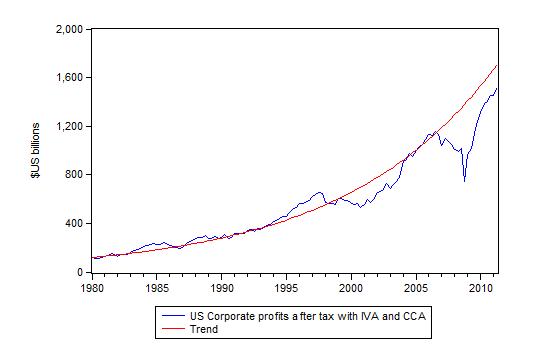
    ... in the early stages of the crisis corporate profits slumped as growth came to a halt and you can see the impact of that in both the following graph and also in the rise in the wage share in the graph presented earlier. But as growth has resumed, the corporate profits series has nearly returned to trend while the wage share continues to fall.
    In other words, what growth there has been since the downturn has been largely captured by capital. Workers have not shared in that growth much at all which explains why consumption is so subdued. The subdued consumption, in turn, reduces the incentive by firms to invest and so they are “cashed up” more than usual at present.


    The major redistribution of national income over the neo-liberal period has been the source of funding for the dramatic expansion of the now (over-sized) financial sector. The reality is that much of the redistributed real income did not return as investment spending but was rather used to buy the gambling chips that the financial sector gambled with.
    There will be massive resistance from that sector to government attempts at re-regulation and redistribution of national income back to workers.
    The UNCTAD Trade and Development Report is also insightful when it comes to dealing with the financial markets:
    Those who support fiscal tightening argue that it is indispensable for restoring the confidence of financial markets, which is perceived as key to economic recovery. This is despite the almost universal recognition that the crisis was the result of financial market failure in the first place. It suggests that little has been learned about placing too much confidence in the judgement of financial market participants, including rating agencies, concerning the macroeconomic situation and the appropriateness of macroeconomic policies. In light of the irresponsible behaviour of many private financial market actors in the run-up to the crisis, and costly government intervention to prevent the collapse of the financial system, it is surprising that a large segment of public opinion and many policymakers are once again putting their trust in those same institutions to judge what constitutes correct macroeconomic management and sound public finances.
    And on the need for fiscal policy to support a process of national income redistribution back to workers, the UNCTAD report also has sound advice:
    … there is a widespread perception that the space for continued fiscal stimulus is already – or will soon be – exhausted … There is also a perception that in a number of countries debt ratios have reached, or are approaching, a level beyond which fiscal solvency is at risk.
    However, fiscal space is a largely endogenous variable. A proactive fiscal policy will affect the fiscal balance by altering the macroeconomic situation through its impact on private sector incomes and the taxes perceived from those incomes. From a dynamic macroeconomic perspective, an appropriate expansionary fiscal policy can boost demand when private demand has been paralysed due to uncertainty about future income prospects and an unwillingness or inability on the part of private consumers and investors to incur debt.
    In such a situation, a restrictive fiscal policy aimed at budget consolidation or reducing the public debt is unlikely to succeed, because a national economy does not function in the same way as an individual firm or household. The latter may be able to increase savings by cutting back spending because such a cutback does not affect its revenues. However, fiscal retrenchment, owing to its negative impact on aggregate demand and the tax base, will lead to lower fiscal revenues and therefore hamper fiscal consolidation … Moreover, making balanced budgets or low public debt an end in itself can be detrimental to achieving other goals of economic policy, namely high employment and socially acceptable income distribution.
    These are all words that can speak for themselves with no further prompting or intervention from yours truly.

    Wednesday, August 3, 2011

    Austerity as Prosperity: The Orwellian Doublespeak of the Right

    Have you ever noticed that the language of conservatives increasingly takes on aspects of Orwellian Newspeak?  Like Nazi propagandists teaching slaves that work makes them free, the rhetoric of the right turns the plain meaning of words on their head.  Arbeit macht frei... except when it's forced labor, which is slavery.

    How else do you explain the notion, apparently all the rage inside the Washington beltway, that Austerity = Prosperity?

    Every single Republicon and Tea Bagger, as well as most Blue Dog Democraps and many clueless so-called pragmatic moderates, has endorsed the idea that in an economic recession/contraction the federal government must "tighten its belt" and "live within its means".  The federal government deficit needs to be reduced [if not closed entirely], and the public debt needs to start being paid down. The social safety net must be shrunk,

    Doing so, they assert, will remove uncertainty from the marketplace & restore business/investor confidence.  Investors will invest in businesses, who will in turn open the jobs floodgates, thereby unleashing pent-up consumer demand that will encourage business to further expand, provide more jobs, yadda, yadda, yadda.  America will enter a new Gilded Age of glorious prosperity that would make JP Morgan jealous.  All this economic booming will eventually fill government coffers with sufficient revenues to retire its massive public indebtedness.  Another supply-side love story.

    Too bad it's a complete fantasy.  Austerity is not Prosperity... as any sane English speaker might suspect.

    In the real world in which we live today, austerity still means... well, austerity. You know, rice and beans for dinner, rags for clothing, that sort of thing.  Prosperity, on the other hand, means lobsters & filet mignon, Armani suits, etc.  Ne'er the twain shall meet.

    Austerity policies do not produce prosperity results, at least in the real world situation we find ourselves in today.  The central economic problem facing the country today, tomorrow and for several years hence is NOT government debt & deficits.  It is, rather, the lack of aggregate demand relative to productive capacity, which is being driven by the debt deflation & private deleveraging occurring as a result of the bursting of the housing bubble. 

    Unless and until the deleveraging - which typically takes many years - is complete, consumer demand will remain depressed.  As long as demand remains depressed, businesses have little incentive to invest or expand or hire workers, resulting in continued long term unemployment.

    Further compounding these depressing dynamics by shrinking government expenditures can only add to the misery.  Reducing discretionary expenditures means less money flowing into the economy, less demand for the goods & services of government contractors & suppliers, less demand for college education (think Pell grants), less demand for basic scientific research, less demand for all the sorts of things that government buys or provides. Shrinking the federal workforce only adds to unemployment.

    You can't fix a demand problem by further reducing demand! 

    This isn't to say that government deficits and debt aren't a problem in the long run.  They are.  Over the long run, we DO need to address our structural deficit problems and begin reducing the public debt to a more sustainable percentage of GDP. 

    But it isn't anywhere near the most important problem facing us today...

    We have time, and the solution - a reasonable combination of:
    • program changes (e.g., a de minimus 1 year increase in the retirement age, federal negotiation of prescription prices, capitated payments for health care outcomes rather than fee-for-service),
    • spending cuts (winding down the Afghan & Iraqi war efforts, elimination of ag subsidies to big business, ) and 
    • revenue raisers (a financial transactions tax, a financial services tax, broad-based individual & corporate tax reforms, removal of the income cap for the SocSec payroll tax, sharply higher/more progressive tax rates on [adjusted] taxable incomes over $100K/$1MM/$10MM/$100MM/$1B) 
    - is well known. 

    Better yet: it is supported by a broad & substantial majority (roughly, 70%, depending upon the specific poll) of the American voting public.

     But the Tea Party trolls and Republicon corporatist plutocrats are not listening.  Unable to speak their Bizzarro world native language, apparently they cannot hear us.

    Tuesday, August 2, 2011

    Everything You Need to Know About Conservative Economic Policies: Interactive | State of Working America

    Interactive State of Working America

    The last 30 years of US economic policy can be largely characterized as a triumph of conservative free market fundamentalism.

    It started with Reagan, who wrote the foreword to an edition of Milton Friedman's smug "Free To Choose", thereby endorsing the core themes of modern movement conservatism:
    • Government is, for the most part, inept, and therefor bad; 
      • Ergo, progressive policies economic policies (strong business regulation, minimum wage laws, strong labor rights, Keynesian counter-cyclical fiscal spending & monetary policy, graduated taxes, a broad social safety net to offset negative externalities & other market failures) represent little more than governmental interference that, at best, achieve less optimal results than the market.
    • Private enterprise in unfettered free markets is optimally efficient, and therefor good;
      • Ergo, conservative policies that limit government's "interference" in the marketplace (minimal to no business regulation, anti-minimum wage laws, anti-labor rights, ever lower taxes [esp. on capital forms of income],  Austrian or Chicago School fiscal & monetary policy,
    • Rational self-interest - "greed" in the language of most religions; "objectivism" in the words of its crackpot philosopher-apologists - represents the highest moral aspiration, and therefor there is no such thing as the "common good" or the collective welfare.

    Bush the Elder, of course, continued the dialogue (the tax increase sin notwithstanding).  Among other things, the S&L scandal - a classic example of conservative regulatory policy coming to its logical conclusion - occurred on his watch.

    Even Clinton ultimately seems to have been won over to the cause.  Pushed by a militant group of Republicon freshmen that seized both houses of Congress, Pres. Clinton enacted NAFTA, implemented anti-progressive Welfare reforms, dismantled the last vestiges of the Depression era legislation separating commercial from investment banking, blocked regulatory oversight of derivatives, and ultimately accepted the "starve the beast" strategy of shrinking government via deficit reduction. He also employed the likes of Larry Summers, Bob Rubin and Roger Altman, and left a lifelong friend and fan of Ayn Rand - Alan Greenspan - in charge of the Federal Reserve.

    Finally, conservatism saw its most fullsome, climactic expression in the tax-cutting, [phony] war-fighting, business-friendly anti-government administration of Bush the Younger.

    Even Obama appears to have bought into the basic premise of conservative economics: make the rich business interests happy (they are, after all, givernment's primary customer).

    What then is the empirical result?

    Everything you need to know is right here:
    Over the last 30 years, 98% of the growth in national income has been captured by the top 10% (most of which actually goes to the top 1%, actually)... leaving only 2% to be shared amongst the bottom 90%.

    A rising tide does not, apparently, lift all boats. It only lifts the yachts.

    The rest of us are bailing furiously, trying to stay afloat.

    Interestingly, during the preceding 33 years of the post WWII era - which can be characterized as the era of liberal progressivism and Keynesianesque government intervention & regulatory oversight (e.g., the New Deal, the GI Bill, Civil Rights, enhanced labor rights, LBJ's Great Society & War on Poverty, etc.) - yielded dramatically different results:

    - Average incomes grew faster (+$19K from 1945~79 versus +$11K during 1980-2008), and
    - the richest 10% only got 31% of it,
    - while the bottom 90% got 69% of the income growth.

    Which era would you prefer to have lived in?

    Economic justice is not only morally superior, it yields greater economic growth & national income.

    Take that, Ayn Rand. Fuck John Galt and anybody who looks like him. The problem with Galt's enclave of ubermen is that  there aren't enough 12-year old girls to kidnap, murder & dissect for the assembled sociopaths... lacking sufficient victims, eventually they must turn on themselves;

    Take that, Hayek and von Mises and Rothbard and all you other anti-scientific Austrian School tautologists. You lost the debate during Keynes' lifetime, and could only score points after he was dead. And even then only because ideological allies (such as Patinkin at Chicago) misconstrued & bastardized Keynes' thought.  Empirical evidence matters; logic fails when the experiment disproves the hypothesis.

    Take that, Paul Ryan. I have to wonder what traumatic event triggered your sociopathic inability to feel empathy for -or- understand the suffering of others?

    Obama needs to fire all of his Council of Economic Advisers, and start over with, e.g., Dean Baker, Joseph Stiglitz, Emmanuel Saez, George Akerloff and Mark Thoma..If not, soon there's going to be a revolution, with mobs in the street wearing "Eat The Rich" T-shirts.

    Monday, January 24, 2011

    Our false view of deficits and money « Comments on Global Political Economy

    Our false view of deficits and money « Comments on Global Political Economy:

    This from self-professed radical small-d democrat Jim O'Reilly at his blog, Comments on Global Political Economy:

    "Our false view of deficits and money
    by Jim on January 21, 2011

    In political debates throughout the developed world, the most prominent divide today is almost certainly that between the needs of society for unemployment safety nets, retirement and pension programs, health care spending, and desired public services versus the demands of the bond market to slash spending in order to reduce budget deficits. The issue is sometimes presented in terms of morality as in “it’s wrong to spend what you don’t have” or “it’s only right that governments, like individuals, manage their finances soundly”. It’s also sometimes presented in a particularly grating parental tone as politicians site a need to have an “adult conversation” with their presumably childlike constituents.

    There are two things about this debate that literally scream out for attention. The first is that it’s a completely contrived and false issue having absolutely no bearing on the true nature of money and debt. Individuals can be in debt to others but it’s utter nonsense to think of societies as somehow capable of being in debt to themselves. Societies are not individuals. The second thing is that a very tiny number of elites along with their political and intellectual supporters derive enormous benefits and power from the view that deficits are important. They’re the monied titans that comprise what we call the “bond market” and we’re repeatedly reminded we must change our ways and appease this apparent force of nature. Obama’s former Director of the Office of Management and Budget Peter Orszag, now lucratively sitting as vice-chairman of global banking at Citigroup, instructs us in today’s Financial Times: “it is … difficult to see the political system embracing that reality (of deficit reduction) without being forced to do so by the bond market”. Another article right along side it, entitled “Only tough reforms can save the land of the rising debt”, warns us “… if Japan does not switch course voluntarily (reduce deficits), it may soon find that financial markets will force changes upon it.” We’ve virtually ceded democracy to those with extreme wealth who, motivated only by private greed, claim a right to decide the limits of possible prosperity within societies. Politicians from “center-left” through the right support them and in turn are supported by them.

    In this post, I seek to make the argument that there’s no sound justification for this transfer of power and there’s every reason to reject the entire discourse and move to a democratically based monetary regime which permits maximum prosperity for all. It’s not too great an overstatement that the key to overcoming most of our problems is a changed monetary system. For is it not clear the technology exists today for widespread prosperity and the only thing holding it back is a lack of purchasing power (i.e. money)? Monetary policy is not mainly an economic issue, it’s political in the deepest sense of the word. It cannot be left in the hands of economists or those in high finance.

    Let’s jump to the central point: we have what is known as a fiat currency. It’s not backed by gold or any other commodity and we, i.e. the government, can issue it without cost by simply crediting a bank account. This immediately should seem strange – is it not the height of lunacy for a government to feel the need to borrow something which it can in fact produce at will? Or to adjust its policies to induce others to lend it back its own fiat currency? The whole thing appears absurd. Is it not equally ludicrous to think we, i.e. the government, must rely on tax receipts in order to obtain this currency? We should pause for a moment and ponder this. If we can create our currency without cost, then clearly we don’t need to rely on taxes or borrowings to generate it. This is counter to all normally accepted intuitions but with only a little thought it must be admitted this is unarguably true.

    This being the case, what is the purpose of borrowing and taxes? The reality is they are not means of generating funds for government spending but are, rather, only monetary tools that serve no purpose other than reducing the money supply. Both taxes and borrowing do the same essential thing – they drain money from the economy. The Federal Reserve, in fact, routinely manages interest rates with this understanding of money and adjusts its borrowing levels on a daily basis to meet its monetary targets.

    Those who claim government spending should be limited to the sum of tax receipts and a low level of borrowing are in fact favoring a policy of austerity that limits societal spending regardless of need. They base their views on an unfounded conception that any monetary spending must be offset by either of the two monetary tools of contraction, i.e. taxes or borrowing. Why should that be? If the economy is suffering from unemployment and underutilized resources, what possible reason exists to think monetary creation needs to be offset by monetary contraction? Yet that is precisely the standard orthodox view of finance. Monetary creation beyond the limits of the economy is certainly unwise and would be inflationary. But why would monetary creation limited to the productive capacity of the economy be so? All past periods of prosperity involved the “printing of money” through private bank credit. The boom in the late 90’s and the recent mortgage boom involved massive private money creation through debt and yet there was virtually no inflation. Why should economists condemn the government printing of money yet not object to the private? Can anyone seriously believe that expanding purchasing power in today’s environment could possibly be inflationary?

    To sum up my argument. The government should create sufficient purchasing power directly through monetary creation in order to provide full employment and utilization of resources. It should only use borrowing and taxes to reduce purchasing power when capacity is being reached and the economy is in need of contraction. Borrowings over an extended term would likely be level as they would decline when the economy was doing poorly and would rise when contraction was needed. Since borrowings are only monetary, interest rates on debt could be maintained at zero percent and so interest on debt would not be an issue. Going further, one can see that borrowings are almost identical to reserves held by banks at the Fed. The government could establish reserve requirements for those with great wealth that would fluctuate depending on monetary policy. This is not the time to expand further on the many options for treating monetary contractionary tools. The critical point is to recognize the monetary nature of it all and the truly democratic opportunities for prosperity that a change in view entails.

    There’s a great deal of theoretical support for this line of thinking. Abba Lerner was an early Keynesian economist who coined the term Functional Finance in the early 1940’s. This key article clearly expresses the monetary nature of debt and the need then (as now) to drop the false notions of financial orthodoxy. The guru of right wing monetarism, Milton Friedman, penned this article in 1948. He recognized the same reality and I would think the article should make those who reject this argument take pause. Friedman argues for eliminating the private banking power to create money and supports “as the chief function of the monetary authorities, the creation of money to meet government deficits or the retirement of money when the government has a surplus”. He concludes that “…government expenditures should be financed entirely by either tax revenues or the creation of money”. By today’s standards his proposal is radical but its general thrust is not too different than what is argued here. There are economists who are making the same points today, including Jamie Galbraith and L. Randall Wray (see here and here). But these perceptive scholars are either ignored or even portrayed as near lunatic. The false undemocratic consensus is that strong.

    It’s well past time we on the left, those who passionately seek a better and more democratic world, recognize the monetary nature of much of our problems and demand our leaders stop creating artificial barriers to our prosperity.

    - Sent using Google Toolbar"

    Wednesday, January 19, 2011

    Debt, deleveraging, and the liquidity trap: A new model | vox - Research-based policy analysis and commentary from leading economists

    Debt, deleveraging, and the liquidity trap: A new model
    vox - Research-based policy analysis and commentary from leading economists


    Debt, deleveraging, and the liquidity trap
    Paul Krugman18 November 2010
    Print EmailComment Republish

    Debt is the crux of advanced economies’ current policy debates. Some argue for fiscal expansion to avoid recession and deflation. Others claim that you can’t solve a debt-created problem with more debt. This column explains the core logic of a new model by Eggertsson and Krugman in which debt shocks and policy reactions can be examined.
    Relying on heterogeneous agents, the model naturally produces the paradox of thrift but also finds new supply-side paradoxes, those of toil and flexibility. The model suggests that most economists have been misthinking the issues and that actual policy in the US and EU is misguided.

    If there is a single word that appears most frequently in discussions of the economic problems now afflicting both the US and Europe, that word is surely “debt.” Between 2000 and 2008, household debt rose from 96% of US personal income to 128%; meanwhile, in Britain it rose from 105% to 160%, and in Spain from 69% to 130%. Sharply rising debt, it’s widely argued, set the stage for the crisis, and the overhang of debt continues to act as a drag on recovery.

    The lack of formal theory
    The current preoccupation with debt harks back to a long tradition in economic analysis, from Fisher’s (1933) theory of debt deflation to Minsky’s (1986) back-in-vogue work on financial instability to Koo’s (2008) concept of balance-sheet recessions. Yet despite the prominence of debt in popular discussion of our current economic difficulties and the long
    tradition of invoking debt as a key factor in major economic contractions, there is a surprising lack of models – especially models of monetary and fiscal policy – of economic policy that correspond at all closely to the concerns about debt that dominate practical discourse. Even now, much analysis (including my own) is done in terms of representative-agent models, which by definition can’t deal with the consequences of the fact that some people are debtors while others are creditors.

    New work that I’ve done with Gauti Eggertsson (Eggertsson and Krugman 2010) seeks to provide a simple framework that remedies this failing. Minimal as the framework is, I believe that it yields important insights into the problems the world economy faces right now – and it suggests that much of the conventional wisdom governing actual policy is wrong-headed under current conditions.

    The model’s economic logic
    We envision an economy very much along the lines of standard New Keynesian models – but instead of thinking in terms of a representative agent, we imagine that there are two kinds of people, “patient” and “impatient”; the impatient borrow from the patient. There is, however, a limit on any individual’s debt, implicitly set by views about how much leverage is safe.
    We can then model a crisis like the one we now face as the result of a “deleveraging shock.” For whatever reason, there is a sudden downward revision of acceptable debt levels – a “Minsky moment.” This forces debtors to sharply reduce their spending. If the economy is to avoid a slump, other agents must be induced to spend more, say by a fall in interest rates. But if the deleveraging shock is severe enough, even a zero interest rate may not be low enough. So a large deleveraging shock can easily push the economy into a liquidity trap.
    Fisher’s (1933) notion of debt deflation emerges immediately and naturally from this analysis. If debts are specified in nominal terms and a deleveraging shock leads to falling prices, the real burden of debt rises – and so does the forced decline in debtors’ spending, reinforcing the original shock.
    One implication of the Fisher debt effect is that in the aftermath of a deleveraging shock the aggregate demand curve is likely to be upward, not downward-sloping. That is, a lower price level will actually reduce demand for goods and services.
    More broadly, large deleveraging shocks land the economy in a world of topsy-turvy, where many of the usual rules no longer apply. The traditional but long-neglected paradox of thrift – in which attempts to save more end up reducing aggregate savings – is joined by the “paradox of toil” – in which increased potential output reduces actual output, and the “paradox of flexibility” – in which a greater willingness of workers to accept wage cuts
    actually increases unemployment.
    Where our approach really seems to offer clarification, however, is in the analysis of fiscal policy.

    Implications for fiscal policy
    In the current policy debate, debt is often invoked as a reason to dismiss calls for expansionary fiscal policy as a response to unemployment; you can’t solve a problem created by debt by running up even more debt, say the critics. Households borrowed too much, say many people; now you want the government to borrow even more?
    What's wrong with that argument? It assumes, implicitly, that debt is debt – that it doesn't matter who owes the money.
    Yet that can't be right; if it were, debt wouldn't be a problem in the first place. After all, to a first approximation debt is money we owe to ourselves – yes, the US has debt to China etc., but that's not at the heart of the problem. Ignoring the foreign component, or looking at the world as a whole, the overall level of debt makes no difference to aggregate net worth – one person's liability is another person's asset.
    It follows that the level of debt matters only because the distribution of that debt matters, because highly indebted players face different constraints from players with low debt. And this means that all debt isn't created equal – which is why borrowing by some actors
    now can help cure problems created by excess borrowing by other actors in the past. This becomes very clear in our analysis. In the model, deficit-financed government spending can, at least in principle, allow the economy to avoid unemployment and deflation while highly indebted private-sector agents repair their balance sheets, and the government can pay down its debts once the deleveraging crisis is past.
    In short, one gains a much clearer view of the problems now facing the world, and their potential solutions, if one takes the role of debt and the constraints faced by debtors seriously. And yes, this analysis does suggest that the current conventional wisdom about what policymakers should be doing is almost completely wrong.

    References
    Eggertsson, Gauti and Krugman, Paul (2010), “Debt, Deleveraging, and the Liquidity Trap”, mimeo
    Fisher, Irving, (1933), “The Debt-Deflation Theory of Great Depressions,” Econometrica, Vol. 1, no. 4.
    Koo, Richard (2008), The Holy Grail of Macroeconomics: Lessons from Japan’s Great Recession, Wiley.
    Minsky, Hyman (1986), Stabilizing an Unstable Economy, New Haven: Yale University Press.